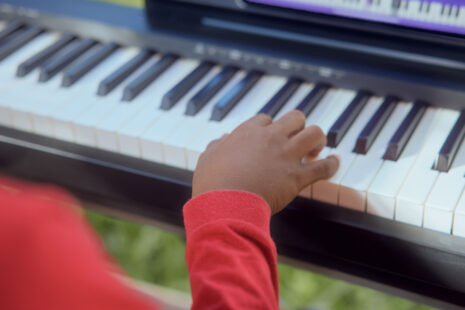
“Children will be drawn to their recorder in a way that will give the word ‘practicing’ a new meaning.”
I have to admit that the summer vacation makes me nervous. Although I do long for some rest after the stressful year, the thought of all my young students disappearing into the big void of computer games, television and ‘doing nothing’ makes me uneasy. Apparently, this is not just my problem. Many teachers report that their students do not touch their musical instruments during the summer vacation, say alone practice. One colleague of mine told to me that “students who like to practice will keep doing so over summer vacation, but students who don’t like to practice – nothing will make them even look at their recorders (not even scolding parents)”. When I asked her how many of her students like to practice, she started to laugh…
On one side I completely understand the students’ point of view. They need rest, they want to have a break from responsibilities, they want to have fun, and practicing isn’t fun. Practicing is boring. But on the other hand, refusing to practice over such a long period of time is hazardous to the learning process of the instrument, and sometimes it can take the student 3-4 months backward.
So what can we do?
Fighting this void and against computer games and TV is really one of the more difficult things there is. I’ve always tried talking to the parents about the importance of maintaining some structure in the summer vacation and it does help in some cases when the parents are more committed. However, in many cases it helped very little or not at all.
A more effective thing I started doing is organizing some sort of mid summer activity with my students. Anything that would be a reminder of what we did during the year. I try to organize a special kind of lesson with fun and social games that have something to do with the recorder – playing a song together one note for each person, “musical chairs” when one of the students is playing-stoping ect. This could be done also with several groups together (if you have a few groups or good colleagues). The point is making it feel like a party, having fun with the recorder and socializing with other recorder students. After such a long time without, I always feel that the kids are more than excited to play again their favorite songs and with their favorite playbacks. An event like that could really help, but there are 2 problem: A. The summer time is very often full of activities (especially for us, musicians) and we can’t always organize something like that. B. It helps, but it still doesn’t solve the problem – in most cases they will not practice their instrument before and after this event.
I don’t know how many of you already tried using JoyTunes-Recorder with your students during the year, but from my and many of my colleagues’ expeirence, this method turned out to be the most effective aid yet during the summer vacation. Having a look&feel of a computer game, my students play it like they would so many other computer games – for hours. They don’t even notice that there are practicing and keeping everything we did during the year fresh.
A colleague of mine, Tchia Rudovski, wrote me about it – “my student came back to a lesson, and it was as if the last time we met was yesterday. He was even in a better condition…”.
I truly recommend it as an elegant summer vacation solution. If we know our students are going to waste so much time playing computer games, why not encourage them to play one that is actually beneficial for recorder.
As a personal note, I truly believe in taking breaks and vacations, but I think it has to be balanced properly. Freedom and rest are effective if they are in the right proportions. Structure is also a comfort zone for most of us, even if we like to complain about it. Children can be lost without a goal, and without motivation, but only a few will admit that. I feel that we, as their parents, teachers and role models – can and should help them find alternatives for their general boredom and “doing nothing” concept…
After learning 2-3 notes (I personally start with B,A and G), here’s a fun exercise that continues to work on basic fingering coordination through ear training.
First, I make them stand in front of me in a half circle. Then, I play for them a short easy sequence with these 2-3 notes, and make them repeat it as a group. If the repetition is terrible, like it often is in the first time, I play it again and make them repeat it again.
Then, I try the same thing, with the same sequence, but standing with my back to them, or behind a screen, if there’s one in the class. Most of them were looking on my fingers when I was playing in front of them instead of repeating what they heard. So this way I help them make the connection to their ears with the help of their memory. I do this exercise a few times – first in front of them, then with my back to them – until I feel it gets better. Alternatively, it’s quite possible to just cover your fingers with the other hand, in case your class is on the hyperactive side…
When they start doing it better, then comes the hard part – I play another sequence, but only with my back to them (or with my fingers covered). Meaning, this time they have to purely rely on their ears, which is very hard for most at first. I try to do this a few times and see how they manage. If they do terrible, I can try giving them a hint, like – “I’m starting with a B”.
As a bonus, and to make it more fun for them, every lesson I can choose one child which would take my place in the exercise. He\She will be playing the simple pattern that everybody has to repeat. Of course to make it work, you would have to be very clear on how many notes are allowed in a pattern, and that you don’t have patience for goofing around…
Have fun!!
This is a question I’ve been thinking about extensively over the years. I’ve heard many opinions and ideas about it, and personally tried many different formulas. Of course it could vary between different circumstances, and needless to say – nothing could substitute the effect of pieces prepared in the highest of qualities. However, I do feel that there is a few main principals that can make a program more effective to the listener, as well as more attractive.
First of all, choosing the repertoire.
From my experience, there are 2 main ways of building a program. The first and most common would be to focus on one topic and build the program around it. This could be one composer, a certain period of time (Italian early baroque, for instance), a certain place (for example, music written in Dresden) or any other topic you could think of. Some of the best ideas I’ve seen were topics that dealt with relations between 2 places, 2 composers, 2 places and so forth. The other way of building a program is to focus on variety, on different styles, different sound colors. This way tries to avoid a situation where your audience is somehow getting used to your sound. It will try to stay fresh in every single fragment of the program. In this way one would search for pieces from different styles, different composers, different places and different times. I’ve seen many musician even go outside the boundaries of western classical music in order to stay fresh and interesting. I think it’s great, though I’ve never really done it myself. I personally prefer focusing on the things I really know. Besides, there are tons of things to work with in our own western classical music country.
Both of these ways have advantages and disadvantages, as you can imagine (or else they probably wouldn’t both exist). The first one establishes a thread of thought that runs through the pieces of the program and connects them together. It very often sounds much better, making it much easier to market. I mean, how many classical CD’s do you know that don’t have a topic like – “Venetian music”, “Bach and Berio”, “Mozart woodwind concertos” ect. The problem is that these good sounding programs could sometimes be quite heavy (if not even boring in extreme cases). Classical musicians often forget that their audience includes in most cases mostly normal people who haven’t studied classical music like they did. The second way holds the potential to be more interesting, and keep the audience “on its toes”, if executed wisely. Of course, it is, from my experience, much harder to market.
I’m not sure how it is in the US, but in Europe, and mainly in Germany, it is quite common that the final exams of a MA degree includes 2 recitals – an “Abchlußrezital”- a whole free recital, and a “Repertoirenachweis”- a recital in which one must play many different styles in order to show he masters them all. I think this is very clever, making the MA student experience and handle both ways of building a program.
After we chose our pieces, we need to think about the program order.
Regarding this, I have developed my own way of thinking over the years. I don’t know if it is the best one, but I’m sure it can help even if you don’t agree with everything written here.
The first thing I do is to think about the first and last piece. These pieces, as I see them, have a crucial part in creating the general impression from a concert. The first piece gives the first impression. Sometimes it gives the general “tone” of the whole concert. That’s why I would choose a very impressive piece, or a piece that it’s impact suits me as a first impression for this program. The last piece is the one most people would “take home with”, the one that would put a point, question mark or exclamation mark to your program. I would choose here something not too heavy, not too long if it’s possible and very important – that would have a strong and effective ending. A nice example I can give for an ending pieces is the York Bowen sonatina op. 121 which has a funny and exciting last movement (you can see a live performance I had with it in Germany in – http://www.youtube.com/watch?v=ClctxDZBUnc.
After we’ve established the beginning and end, we already know where we’re starting and where we’re going, and we can start giving the program a shape. Very heavy pieces would be placed rather sooner in the program and balanced with lighter ones near them. If one chooses to have a pause in the middle, my advice is to balance the 2 halves in terms of length and heaviness. If you can’t, it’s better to have the first half a bit longer and heavier than vice versa. Another option to having a break is taking a 1-2 minute pause between every piece. This can give time to rebuild the stage if needed and to gather one’s thoughts for the next piece.
A wonderful way to make a program more effective is simply to moderate a little bit. Moderation, though not always appropriate, is a wonderful way to give the audience interesting information about a piece, to share some thoughts and ideas about it and break the distance between the performer and the audience. If the situation is right, I would always prefer to say a few words, and believe me – people love it! They feel closer to you as a person, closer to the music they now know a little bit better and have a bit of information to clung on to as they are listening. It takes some practice, but moderating can sometimes really make a difference.
Good luck with your programing!